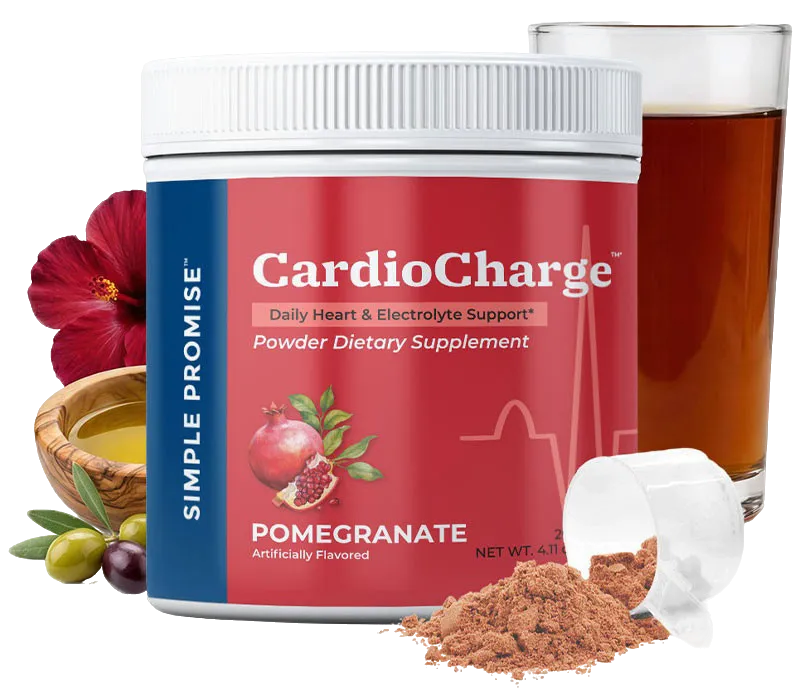
The ingredient list is where a supplement either earns trust or loses it. CardioCharge prints seven ingredients with amounts, which makes comparison easy. This article puts them side by side, groups them by function and flags what to consider before you buy. For the formal write-up, the ingredients page has a section for each one.
The Seven Ingredients at a Glance
Per serving, the label shows D-Ribose 3,000 mg, L-Glycine 1,000 mg, hibiscus flower extract (4:1) 470 mg, potassium 380 mg, magnesium 190 mg, sodium 140 mg and Hytolive® olive extract 30 mg. The tub holds 20 servings and is flavored pomegranate.
Seen as a group, the formula splits neatly into three families: electrolyte minerals, plant polyphenols, and energy plus amino acid nutrition.
Family One: The Electrolyte Minerals
Potassium (380 mg)
Potassium lives mostly inside cells and supports fluid balance, nerve signaling and muscle contraction. It is supplied as potassium citrate. Adults with kidney issues or a potassium limit should ask a professional first, since the home-page overview and the potassium entry both carry that note.
Magnesium (190 mg)
Magnesium supports hundreds of enzymes and is involved in energy metabolism, muscle function and nerve signaling. CardioCharge uses magnesium glycinate, a form bound to glycine. It straddles two families, because it is an electrolyte and an energy helper at once.
Sodium (140 mg)
Sodium works with potassium to keep fluid on the right side of cell membranes. At 140 mg it is a modest amount, but it still counts toward your daily total, which matters if you follow a low-sodium diet.
Family Two: The Plant Polyphenols
Hibiscus flower extract (470 mg)
Hibiscus is the tart flower used in many herbal teas, and the 4:1 label means roughly four parts of flower per part of extract. It contributes anthocyanins and other polyphenols and gives the drink part of its tangy character. It has been researched alongside blood pressure, so anyone on blood pressure medication should check with their clinician.
Hytolive® olive extract (30 mg)
Hytolive® is a branded extract from olive fruit that carries hydroxytyrosol and related polyphenols. It is the smallest amount in the tub, yet standardized extracts concentrate their active compounds, so small milligram numbers can still be deliberate.
Family Three: Energy and Amino Acid Nutrition
D-Ribose (3,000 mg)
D-Ribose is a five-carbon sugar that forms part of ATP, the energy currency of cells. It is the largest ingredient in the formula, which tells you where the designers placed their emphasis. Our article on how CardioCharge supports daily energy explains why.
L-Glycine (1,000 mg)
Glycine is the simplest amino acid and the body uses it to build proteins, including collagen. It is also the partner molecule in magnesium glycinate, so the two share a chemical link. In this formula it supplies general amino acid nutrition and is not described as acting on the heart directly.
How the Seven Compare
- Biggest dose: D-Ribose, then L-Glycine.
- Most heart-nutrition relevance: potassium, magnesium and hibiscus.
- Most research attention as a single ingredient: hibiscus and D-Ribose.
- Most caution needed: potassium, sodium and hibiscus, for people with kidney, sodium or blood pressure concerns.
- Smallest dose: Hytolive® olive extract.
What Is Not in the Tub
There is no caffeine, no stimulant and no sugar. The flavor is artificial, according to the label. That absence is part of the pitch, and it is easy to verify by reading the printed facts on the tub that arrives.
How to Read the Label Wisely
Three habits help with any supplement. First, compare amounts, not marketing words. Second, check whether you already get the same nutrients elsewhere, because stacking several mineral products can overshoot. Third, bring the label to your clinician if you have any medical condition. Our review page places these cautions next to the strengths so you can weigh them evenly.
Outside References
For neutral background on the minerals, the NIH Office of Dietary Supplements publishes consumer fact sheets on potassium and magnesium, and the American Heart Association discusses sodium. The official overview and the heart health article connect these ideas back to the product.
Questions People Ask About the Ingredient List
Is there a hidden proprietary blend?
No blend hides the amounts. Each of the seven actives has its own milligram figure on the facts panel, which is the main reason the label is easy to compare with other electrolyte or heart-nutrition products.
Why is D-Ribose so much larger than everything else?
Ribose is a simple sugar-like nutrient that is typically used in gram-level amounts, not tiny ones. Seeing 3,000 mg beside a 30 mg olive extract is therefore normal, and it simply reflects how each ingredient is usually dosed.
Could I get these from food instead?
Partly. Potassium and magnesium are plentiful in produce, legumes and nuts, and glycine comes from protein foods. Hibiscus tea and olives supply their own polyphenols. A powder is a convenience, not a requirement, and the heart health article keeps that perspective.
Summary
CardioCharge has a compact formula in which every ingredient has a stated amount and a clear role. It is a nutritional product, and the ingredient list supports that description well. Return to the CardioCharge home page whenever you want the overview again.
CardioCharge essentials: CardioCharge home page official overview reviews ingredient breakdown